
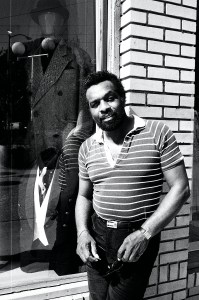
The author copies of BMG’s “30th Anniversary” edition of my first book just showed up, complete with a foreword by country-soul king William Bell (right) dozens of previously-unseen photos taken in 1985 by my accomplice Muir Mackean. Here are the first few paras of the new introduction I wrote for it…
NAMED AFTER an extemporary yelp in the fadeout of Kip Anderson’s bereft 1968 single “I Went Off and Cried,” Say It One Time for the Brokenhearted was my first book. Revisiting it for the second time in 30 years, it feels, in places, as callow and earnest as I was myself at age 26, when I wrote it. I’d retroactively fallen in love with a sub-genre of American popular music that barely had a name, and I was close to evangelistic in my desire to turn people on to it.
The book’s original 1987 subtitle was The Country Side of Southern Soul, its cover sporting an awkward splice of a tuxedoed Ray Charles wearing a Stetson hat. (Tuxedo = soul, Stetson = country: you get the drift.) Brother Ray had, of course, been one of the prime movers in bringing black and white music together—he followed up his groundbreaking Modern Sounds in Country & Western Music albums from 1962 with the even more explicitly titled Country & Western Meets Rhythm & Blues, a.k.a. Together Again, in 1965—but not even he used the term “country soul,” which became part of the revised subtitle for Say It’s 1998 reissue and stays in place for this updated edition. I’m fairly sure I first encountered the phrase in Charlie Gillett’s groundbreaking history The Sound of the City (1970).
As I now look back to the early 1980s, when I first wrote about music for the NME, I ask myself why “country soul” got under my skin to such a degree that I decided to write a whole book about it. Naturally I loved the music, but there was more to it than that: something poetic, something almost mystical. Learning, as a schoolboy, that Aretha Franklin had recorded her breakthrough Atlantic single “I Never Loved a Man”/“Do Right Woman, Do Right Man” in a tiny studio in (of all places) Alabama—engineered, moreover, by a local white man named Rick Hall—gave me a thrill and instilled a curiosity that led me on a long and winding journey to—well, the very studio where Franklin made that record…
Don’t delay: Buy Say It One Time for Brokenhearted here…
 barneyhoskyns.com