The Testimony of Robbie Robertson

robbie-robertson-testimony-glory

MOJO gave me a mere 150 words on this, but here’s my tuppenceworth on “an unengaging and soulless read”…

THE BAND’S STORY continues to beguile: how did a group so rich in talent and promise implode so hopelessly, only to pull the rabbit out of the hat with such a spectacular leaving do?

Almost a quarter century after the late Levon Helm published his own autobiography, de facto Band leader/guitarist/songwriter Robertson finally has his own say in the solemnly-titled Testimony. (Did he, one wonders, wait for Levon to go before committing pen to paper?)

The sad truth is that Testimony makes for an unengaging and soulless read. While there’s much to learn and many gaps filled in for the curious, the book is written in a clichéd style of numbing if self-regarding banality. However much sympathy one has with Robertson’s desperate attempts to herd The Band’s cats, there’s rarely the sense here of a flesh-and-blood human being behind the rote recollections.

Helm’s book may have been written by Stephen Davis, but the drummer’s irresistible voice was audible in its every phrase.

Us and Them

Donald Trump Campaigns Along SC Coast One Day Ahead Of Primary

I told my friends I wouldn’t say another thing,

for really what more can be said

of something so beyond belief, except it hurts

that millions blind themselves so willfully to what he is:

a lacquered pig who peddles venom

and a puffing pride in something called “America” –

what is that gross abstraction anyway? –

but who has never done a thing to aid the working stiffs

who grope between the legs of battered chicks.


Now all right-thinking lefties who despair of “them” –

the Muslim-bashing truckers

with their God ‘n’ guns ‘n’ strung-out sons,

the trailer trash without a hope in hell

of getting through December –

get to choose who we hate more:

the Wall Street masters of the universe,

eviscerating industry with algorithmic skill,

or monstrous demagogues who stir

the bubbling undertow of human fear.

Was Bert Berns the Greatest White Producer of Black Soul?

1401731393bert_berns_sol_burke_666

YESTERDAY I WAS lucky enough to see the UK premiere of Bang!, Brett Berns’ exceptional doc about his dad, who co-wrote and/or produced at least a dozen of the greatest R&B/soul records to come out of New York City in the ’60s: ‘Cry to Me’, ‘Cry Baby’, ‘Piece of My Heart’, ‘I’ll Take Good Care of You’, ‘Are You Lonely For Me, Baby’, ‘Twist and Shout’, ‘It’s All Over’, ‘I Don’t Want to Go On Without You’, ‘It Was Easier to Hurt Her’, ‘Tell Him’, ‘A Little Bit of Soap’ and ‘Down in the Valley’.

(That’s without even mentioning his considerable success with such white “pop” artists as the McCoys, the Strangeloves, and of course Them/Van Morrison and Neil Diamond.)

Bang! is a thrilling, moving and at moments very funny film about a remarkable character, a Jewish hustler who loved African-American singers, Cuban dance rhythms, and Italian mobsters in equal measure. In a Q&A after the Doc’n’Roll screening in London, Brett Berns said “the sands of time” had covered over his father’s achievements, and that he’d set out years ago with the principal aim of getting Bert into the Rock & Roll of Fame. That finally happened this year, a testament to Brett’s perseverance and belief, but it’s been an arduous process. I recall meeting Joel Selvin in New York in 1998 when was he was doing preliminary research for his ace Berns biog Here Comes the Night, a primary source for Bang!, with excerpts narrated by Steve Van Zandt.

brett-berns

Thank god Brett had the presence of mind to start interviewing acquaintances and colleagues of his father’s long before he was able to garner any interest in the project: Bang! really feels like a labour of love and devotion, boasting irresistible interviews with Bert’s take-no-shit widow Ilene (Brett’s mom); with an enthroned Solomon Burke and with Betty Harris and Brenda Reid (of the Exciters); with surprisingly endearing mobster Carmine “Wassel” DeNoia (who brought the great Freddie Scott to Berns); with his greatest writing partner Jerry Ragovoy; and with a host of the hilarious music-biz Jews who adored Berns (though not with Jerry Wexler, the G – as in Gerald – of Bert’s Bang! label, and someone who doesn’t emerge from the film too well despite being Brett’s godfather).

Doubtless as a result of project’s slow-building momentum, Brett was eventually able to interview Paul McCartney, Keith Richards and Van Morrison – all of whom were touched directly or indirectly by Bert – but predictably they don’t provide much more than cliché in conversation (and Van doesn’t mention the fact that Wassel once smashed an acoustic guitar over his head in New York’s King Edward Hotel… or perhaps Brett had to edit it out).

The only gaping omission in this fine film is any vivid impression of Berns himself, given the regrettable absence of interview footage with the man. But there is a wonderful piece of session audio in which Bert coaches the magnificent Betty Harris through the opening line of ‘It’s Dark Outside’ – and it tells you all need to know about this deeply soulful cat and the big heart that gave out on him on a bitterly cold day at the end of December 1967.

See Bang!, read Here Comes the Night, and plunge back into those gloriously overpowering soul ballads.

Oh, and here’s a MOJO piece I wrote on Berns back in March 1998…

filmstill-76

Bert Berns: The Soul Man with a Huckster’s Heart

HE WAS, said Jerry Wexler (above right), “a paunchy, nervous cat with a shock of unruly black hair”. He looked like a vaguely disreputable cross between Gene Vincent and Denholm Elliott. He liked the company of gangsters, and he boasted that he’d run guns and dope in the Havana of the 1950s.

But Bert Russell Berns was also a master of symphonic soul, of the uptown New York sound that combined cascading orchestration with drenching gospel vocals. He made the kind of records Bacharach and David might have cut had they ventured down to Stax, or Pomus and Shuman down to Muscle Shoals: stupendous soul singles like Betty Harris’ ‘Cry To Me’, Solomon Burke’s ‘Goodbye, Baby (Baby Goodbye)’, Ben E. King’s ‘It’s All Over’, and Freddie Scott’s ‘Are You Lonely For Me’. In partnership with Jerry Ragovoy, Berns wrote and produced orgasmic soul ballads by Garnet Mimms and Erma Franklin, whose scorching ‘Piece Of My Heart’ has been covered by everyone from Big Brother & the Holding Company (1967) to Shaggy (1997).

“He was a great writer, a great man,” said Solomon Burke. “‘Cry To Me’ [1961]… was really soul music. It wasn’t like pop at that time, it wasn’t country, it wasn’t like R&B. The only way it could be classified was soul music. That’s when it all started.” High praise from a man who, according to Jerry Wexler, actively disliked the cocky, street-smart Berns.

Berns had learned his smarts in the Bronx, where he was born to Russian immigrant shopkeepers on 8 November 1929. He studied classical piano as a child, and possibly even attended the famous Juilliard music school. Employment during the ’50s came in a variety of forms: work as a salesman, as a music copyist, and finally as a session pianist. Smitten with salsa, he headed south to Cuba and soaked up the quajira rhythms of Havana – rhythms that would come to serve him well in the early ’60s. (Jerry Wexler remarked that Berns made a virtual cottage industry out of the chord changes to ‘Guantanamera’.)

Returning to New York at the end of the ’50s, Berns took a job as a songplugger with Robert Mellin Music, just down the road from the Brill Building on Broadway. Under the pseudonyms Bert Russell and Russell Byrd, he wrote songs – and even recorded them – for labels like Laurie and Wand. With Phil Medley he wrote ‘Twist And Shout’, a song massacred by Jerry Wexler and Phil Spector when they produced a sorry version for Atlantic vocal group the Top Notes, but then revived by Berns himself when he produced the 1962 version by the Isley Brothers. Other early hits included the Jarmels’ ‘Little Bit Of Soap’ and The Exciters’ ‘Tell Him’.

Work for Atlantic began in late 1960. “He just came off the street one day and started demonstrating songs to me,” recalled Jerry Wexler. “He had so many ideas and licks that I said, ‘We’re gonna produce some records together’.” Taking over the Drifters from the departing Leiber and Stoller, Berns produced ‘At The Club’, ‘Saturday Night At The Movies’, and the group’s last great single, ‘Under The Boardwalk’ (1964), with its sombre Berns-Wexler-composed B-side ‘I Don’t Want To Go On Without You’. For Solomon Burke he produced ‘Cry To Me’, ‘The Price’, and ‘If You Need Me’, and co-wrote ‘Down In The Valley’ and ‘Everybody Needs Somebody To Love’ (a song Burke described as “our gospel march”). Wexler even put new signing Wilson Pickett with Berns for one single, the gloriously misjudged but ‘Come Home, Baby’. “Bert had Pickett crooning, something like Ben E. King, and it was a flop,” Wex said.

In 1963, fate had brought Berns together with Philly-based writer-producer Jerry Ragovoy, and he wound up splitting the royalties on the sublime lamentation that was Garnet Mimms & the Enchanters’ ‘Cry Baby’ – backing vocals courtesy of Cissy Houston and the Warwick sisters. “Bert was a meat-and-potatoes four-chord basic kinda guy with a street feel that other people would have killed for,” Ragovoy told Al Kooper. “I think his talent far exceeded mine, but he couldn’t really hear past four chords, and comparatively I was sophisticated. So I would come up with a fifth chord and he’d give me that look and say, ‘What is that, bebop?'” After several more Mimms beauties – ‘It Was Easier To Hurt Her’, ‘I’ll Take Good Care Of You’ – Ragovoy took the uptown soul sound to a delirious extreme with Lorraine Ellison’s volcanic ‘Stay With Me’ (1966).

Booming drums, mournful horns, gospel keyboards, wailing female vocals: these were just some of the ingredients Berns utilised to produce such sobbingly cathartic sides as ‘Cry Baby’, ‘Cry To Me’, and Ben E. King’s 1964 masterpiece ‘It’s All Over’. There’s a lot of raw despair in these records, but it’s a despair held in check by the craft of the arrangements. “I never met anyone who understood pop so well,” wrote Nik Cohn in Awopbopaloobopalopbamboom. “He was an identikit American record man, canny and tough and flash, always money-conscious… he wasn’t a beautiful person but he was intelligent, articulate and he made some good lines.”

Cohn met Berns in “a decaying West Hampstead caff” in mid-1965, on one of the trips Berns made to London to produce Them and Lulu for Decca. Ironically, given the group’s cover of Twist And Shout, Berns could see that the Beatles were sounding the death-knell for Brill Building pop. “These boys have genius,” he told Cohn. “They may be the ruin of us all.” This may be partly what had sparked his interest in Them, and especially in the band’s truculent frontman Van Morrison. “Bert was a very creative, dynamic guy,” Phil Coulter, right-hand-man to Them’s manager Phil Solomon, told Johnny Rogan. “He beat the band into shape. It had always seemed like Van Morrison and a bunch of geezers. But without diluting their rawness, Bert gave them a lot of cohesion.”

The cohesion even extended to the hiring of “Little” Jimmy Page on lead guitar for the session that produced ‘Baby, Please Don’t Go’ b/w ‘Gloria’. Them had an even bigger hit with Berns’ own ‘Here Comes The Night’, which reached No.2 in March 1965 and even cracked the American Top Thirty. Indeed, Berns believed in Morrison’s talent enough to send him a one-way ticket to New York after Them had split up, and to sign him to the Bang! label he had formed in partnership with Jerry Wexler and Ahmet and Nesuhi Ertegun.

Taking his place on a roster that included the McCoys and Neil Diamond, Morrison soon found that Berns was giving him less than his undivided attention. Apart from the enduringly charming ‘Brown-Eyed Girl’, which made the American Top Ten in August 1967, the tracks cut in New York with Berns – including the epic ‘T.B. Sheets’ and early, Dylanesque versions of Astral Weeks‘ ‘Madame George’ and ‘Beside You’ – left Van deeply unhappy. For all of Berns’ desire to break the mold, his business style was still pure Broadway hucksterism – and utterly inappropriate for Morrison, who recorded a series of songs with nonsensical lyrics to fulfil his Bang contract. (A propos the business style, Jerry Wexler claims that things “started to get funny” with Berns in 1967, and that there “signs that he was running with wise guys”. When Berns sued Atlantic for breach of contract, Wexler and the Ertegun brothers “said goodbye to Bang”.)

The story goes that Berns brought ‘Piece Of My Heart’ to Morrison and asked him to help him finish the song. When Van declined, Berns took the song instead to his old partner Jerry Ragovoy, who came up with the immortal “Didn’t I make you feel like you were the only man” opening line and completed most of the verses to go with Berns’ lacerating chorus. Recorded by Aretha Franklin’s sister Erma, it became the twenty-first single on the Shout label that Berns had formed in 1966 as a soul counterpart to Bang – and which had already released one bona fide classic in Freddie Scott’s funky ‘Are You Lonely For Me’. (When Keith Richards was asked to pick his desert island Top Ten in 1986, he chose both ‘Are You Lonely For Me’ and ‘Piece Of My Heart’.)

‘Piece Of My Heart’ was Berns’ last great soul production, but not the end of his influence on pop music. Janis Joplin, for starters, would go on to record ‘Cry Baby’, as well as two further Jerry Ragovoy songs, and the Blues Brothers would turn ‘Everybody Needs Somebody To Love’ into their very own sanctified anthem. Occasionally someone else draws on the deep well that was Berns’ musical spirit and offer up a slice of deep orchestral soul in a spirit of homage to the man Solomon Burke – mistaking the man’s heritage – called a “paddy motherfucker”. When Maria McKee and Sam Brown collaborated on a track for McKee’s 1993 album You Gotta Sin To Get Saved, they came up with the ecstatic ‘I Forgive You’, a magnificent tribute to the man who keeled over from a heart attack in a Manhattan hotel room on 30 December, 1967.

“Berns was a soul savant, a backroom white soul brother,” writes his son Brett in the liner-note to a double-CD package of Berns classics serviced to the industry this summer by the Sloopy II Music company that administers his publishing. Jerry Wexler, who did not attend his funeral, said that Berns was “eclectic, a tireless go-getter and hitmaker”. Few unsung heroes of ’60s soul are more deserving of a place in the pantheon.

The Best of Bert

The Isley Brothers: Twist And Shout (Wand, 1962)

Betty Harris: Cry To Me (Jubilee, 1963)

Garnet Mimms & the Enchanters: Cry Baby (United Artists, 1963)

Solomon Burke: Goodbye Baby (Baby, Goodbye) (Atlantic, 1964)

Ben E King: It’s All Over (Atco, 1964)

Them: Here Comes The Night (Decca, 1965)

Garnet Mimms & the Enchanters: I’ll Take Good Care Of You (United Artists, 1966)

Freddie Scott: Are You Lonely For Me (Shout, 1966)

Van Morrison: Brown-Eyed Girl (Bang, 1967)

Erma Franklin: Piece Of My Heart (Shout, 1967)

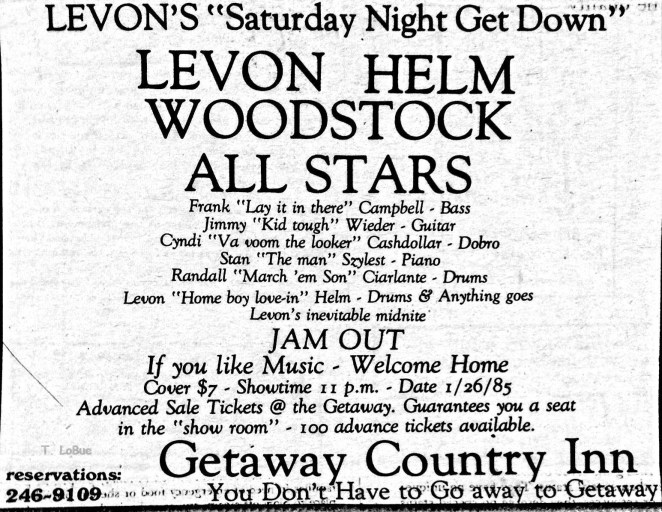
Robbie and Levon

Robbie Robertson comes in for a bit of a pasting in a Harper’s review of his autobiography Testimony (or at least on page 1 of it, the only one available to non-subscribers)… and I get a namecheck too. I’m about halfway thru’ the aforementioned tome and finding it fairly soulless, frankly.

Meanwhile here’s the (slightly sad) flipside of the Band story:

levon-at-getaway

Reckless Joni Mitchell

14729181_10154468300820977_1647523583169456790_n

Just taken delivery of the Rock’s Backpages JONI anthology, Reckless Daughter, published by Constable/Little, Brown on November 3rd. Here’s my intro to the collection…

Our Lady of Sorrows

On the afternoon I interviewed Joni Mitchell, in September 1994, she was in the most infectious of moods: giggly, garrulous, bordering on flirtatious. When we were done talking, she hammed it up for the photographer on the street, just around the corner from her manager Peter Asher’s office on West Hollywood’s Doheny Drive.

I’ve always felt privileged to have met this genius of North American music, this Canadian prairie maid turned folk poetess turned canyon confessor turned jazzbo hybridiser turned… well, never mind the many shapes Mitchell’s shifted over half a century. Let’s just agree she’s peerless and untouchable as a singer-songwriter of intricate lyrics and swoopingly beautiful melodies.

Her words and her “weird chords” you can read about at length in the pieces pulled together in this compendium. Included in Reckless Daughter are some of the most open and thoughtful interviews Mitchell has ever given, as well as some of the finest snapshots of her complex, often spiky personality. Here are reviews of (almost) all her albums – the consensus masterworks, the curate’s eggs – and of live appearances she’s made in tiny clubs and glitzy concert halls. Here are the words of writers who’ve fallen, as I did, under the spell of her piercing honesty, her tingling musical intimacy, her coolly nuanced moods: Americans and Brits alike, men and women who know how uniquely brilliant she is.

Some would say Mitchell has been her own worst enemy – has too often bitten the journalistic hands that stroked her. I choose to think she’s struggled to bear the weight of her talent and intelligence in an arena better disposed to the crass and the facile. True, she might have made life easier by not being quite so savage about the “three-chord-wonder” strummers who identify themselves as her disciples – but then why pretend they aren’t mediocrities when so many queue up to crown them the New Jonis? And when an artist has given us ‘The Arrangement’, ‘River’, ‘Car on a Hill’, ‘The Boho Dance’, ‘Amelia’, ‘Dog Eat Dog’, ‘My Secret Place’, ‘The Magdalene Laundries’, ‘Man from Mars’ and ‘If I Had a Heart’ – to offer a random smattering of marvels that span the length and breadth of her work – who are we to judge her character?  Many of Mitchell’s songs are great art. Almost all are emotionally complex, musically gripping. From the earliest virginal days of ‘Chelsea Morning’ to the late, husky despair of Turbulent Indigo‘s ‘Sex Kills’, Joni’s is a voice that belongs to her alone. So we should excuse her occasional impatience with the received idea that she is godmother to those who do nothing more useful than string together stale chords and trite musings and call them songs.

Granted, Mitchell’s own earliest compositions sound somewhat fey today. ‘Urge For Going’ and ‘Both Sides Now’ have a kind of fluting, pellucid innocence about them, while even she acknowledges that the winsome ‘Circle Game’ only has any currency these days as a campfire singalong. The first hint of her defining gravitas came with ‘Woodstock’, a song of starry-eyed hippie faith that, with its shimmery electric piano and curiously yodelled vocals, sounded a simultaneous note of dread. Personally I go a bundle on the grainy maturity of her vocal persona on such ’90s songs as ‘Passion Play’, ‘Come In From The Cold’ and ‘Nothing Can Be Done’, but they’re not to everybody’s tastes.

In these pages you’ll find Paul Williams, acknowledged founder of rock criticism, and Ellen Sander, one of the first women to write about pop. You’ll find Michael Watts and Geoffrey Cannon, subtle British commentators from rock’s first golden age. You’ll find keyboard player Ben Sidran on Joni’s homage to cantankerous jazz maverick Charlie Mingus, as well as considered appreciations – not always raves – of Mitchell’s art by Wesley Strick, Susan Whitall, Sandy Robertson, Joel Selvin and others. You’ll get the fine words of Tom Nolan, Loraine Alterman, Mick Brown, Ben Fong-Torres, Fred Goodman and many more.

Here is most of what you could ever want to know about Joni Mitchell, a towering troubadour and sometimes reckless daughter of America’s folk-rock revolution.

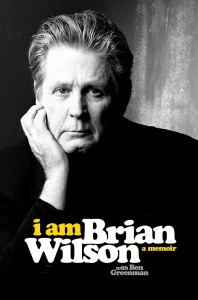
He is Brian Wilson

i_am_brian_wilson

I’m back down at the Cheltenham Lit Fest this Sunday Oct 16th (12.30-1.30 pm) to discuss the troubled genius of B.W. with Will Hodgkinson and Lisa Verrico… in the interim, here’s a piece I penned over 20 years on the notion of pop genius and the birth of the Brian cult:

“Brian Wilson is a Genius”: The Birth of a Pop Cult

The Independent, 1 September 1995

One of the key moments in I Just Wasn’t Made For These Times, record producer Don Was’s black-and-white film about Brian Wilson of the Beach Boys, is a sequence of home-movie footage accompanied by a home-recorded demo of a song called ‘Still I Dream Of It’.

As we watch the Brian of 1966 playing with his daughters in his Beverly Hills garden, we hear the Brian of 1976 – at the nadir of his drugged-out retreat from reality – tunelessly croaking ‘Still I Dream Of It’ at the piano. The juxtaposition of the images of Brian in his prime with the sound of the man at his most regressed is painfully poignant. Most pathetic of all is the lyric: “Time for supper now /Day’s been hard and I’m so tired, I feel like eating now / Smell the kitchen now, hear the maid whistle a tune, my thoughts are fleeting now…

Yet this song is precisely about the way Brian is still somehow connected to a redemptive realm of beauty. “Still I dream of it“, he sings with a pang of desperation, “and it haunts me so /Like a dream that’s somehow linked to all the stars above…” It’s as if he is pining for the lost muse that inspired him to write the sixties masterpieces he described as “symphonies to God” – songs like ‘Surf’s Up’, ‘God Only Knows’, and ‘Don’t Talk, Put Your Head On My Shoulder’ … not forgetting ‘I Just Wasn’t Made For These Times’.

For Don Was, who has included the ‘Still I Dream Of It’ demo on the soundtrack album released to coincide with I Just Wasn’t Made For These Times, the song’s pathos is irresistible. As a life member of The Brian Wilson Appreciation Society, he is fully committed to the legend of the man’s genius. He knows, too, that pop is almost as haunted by the achievement of Brian Wilson as Brian is haunted by “it” – by whatever it was precisely that his genius allowed him to apprehend or intuit at the height of his melodic powers.

The phrase “Brian Wilson Is A Genius” was first magicked up one afternoon in the summer of 1966 by Derek Taylor, the former Beatles press officer who’d moved to Los Angeles in 1965. Pet Sounds had just been released, and everyone knew that Brian had crossed some invisible line between pop ephemerality and genuine musical brilliance. Taylor was simply canny enough to make it official, and to validate pop music in the process. Within days, “Brian Wilson is A Genius” was a buzz phrase in Swinging London, where the Beatles received Pet Sounds with something akin to awe.

Hard-core Beach Boys fans will know that Pet Sounds failed to reach the top ten in America, and that Brian never managed to complete Smile, its intended follow-up. (A three-CD box set of Smile tracks and fragments, The Smile Era, is due for release this autumn). Smile was to have been Wilson’s ultimate “symphony to God”, but a heady combination of lysergic acid and inherent mental instability led to his virtual breakdown, and eventually to a total retreat from the music industry. This breakdown – the failed promise of Smile, that Holy Grail of pop – is central to the obsession many people have with his lost greatness.

“Genius” is actually a rare commodity in pop music; it’s not a word bandied about idly. We don’t call Hendrix a genius, or even Dylan. Genius has less to do with rock heroes than with pop solipsists, mavericks who invent their own sonic worlds to live in. Pop geniuses, we feel, are baffling talents who could have lived in any era. It is remarkable how many of them, in our minds, are hunched over keyboards rather than letting rip on electric guitars. The image of the adolescent Brian Wilson, pouring out his feelings alone at the upright in his bedroom, remains a potent one.

Wilson provides the link between pop and the undisputed greatness of Tin Pan Alley songwriters like George Gershwin, whom he idolised. The miracle of Brian’s melodic gifts, like those of Lennon and McCartney, even prompts comparisons with Mozart and Schubert. As Tom Petty puts it in the documentary, “I don’t know if he’s a genius or not, but I know that that music is probably as good a music as you can make … as you can write.” The particular appeal of his genius lies in the fact that the Beach Boys were the very obverse of hip – the unlikeliness of these songs growing out of disposable surf pop – and in the singular naivety and ingenuousness of his personality.

If there was a pop genius before Wilson, it was Phil Spector, another of the Beach Boys’ heroes (though note that Ray Charles had been referred to – on several of his own album titles! – as a genius.) Spector had the necessary megalomania and flamboyance to imprint himself on his productions, and to envision pop as something heroic and Wagnerian. The failure of his mightiest creation, Ike and Tina Turner’s ‘River Deep Mountain High’, resulted in a retreat from reality similar to Brian’s. It is ironic, given that he was barely capable of writing a song, that Spector is lauded as a genius more often than even John Lennon or Paul McCartney.

When Julian Cope compiled an album called The Godlike Genius of Scott Walker in 1981, he was investing heavily in the enigma of the teen heart-throb turned existentialist recluse. Pop stars weren’t meant to sing Jacques Brel songs or seek inspiration in Ingmar Bergman films. As with Brian Wilson, there was something kitsch about the doomed introspection that lay behind Walker’s appeal, but his subsequent stretches of silence, broken only by music of impenetrable spookiness, have confirmed his status as pop’s premier cult hero.

The figure of the doomed troubadour is particularly susceptible to having the mantle of Genius laid over his fevered brow. Singers as different as Nick Drake, Tim Buckley, Arthur Lee and Alex Chilton – the first two dead, the latter pair all but spent forces – have been hailed as geniuses and become the objects of cult worship. In all four cases, the element of tragedy and failed promise is a crucial factor. Genius must be accompanied by torment, we feel, or the very least by major eccentricity. In the realm of black music, both Stevie Wonder and Prince meet at least two of the requirements of genius: they’re both mad and they’re both multi-instrumentalists. As for female stars, perhaps only Kate Bush qualifies as a genius in rock’s obstacle race. Once again, it is significant that one thinks of her first and foremost as a composer at the keyboard.

Casualties of the criteria sketched above include the many composers (Burt Bacharach, for example) who have worked as part of a team: the essential solitariness of a writer like Jimmy Webb seems more alluring to pop theorists and dreamers. True, Brian Wilson worked with several lyricists: his chief accomplice on the Smile songs was that other cult “genius” Van Dyke Parks, whose playfully cryptic couplets so unsettled the other Beach Boys that they effectively put an end to the partnership. But Wilson was always so lost inside his own musical universe that the word “collaboration” seems inaccurate. “I know that I’m not a genius, and it’s a great embarrassment to me to be thought of as one,” says Parks, whose own new album Orange Crate Art features vocals by Brian Wilson. “I’m not a natural, unlike Brian. He sits down and plays something in the same key in which I played it for him thirty years ago. This guy is absolutely brilliant. There’s not enough I can say about his abilities.”

In Thomas Mann’s novel Doctor Faustus, musical genius is a pact with mental torment. In the story of Brian Wilson, it is almost as if the man’s supernatural talents were the direct result of the damage he suffered as a child. Let’s leave the last word to Tony Asher, another of Wilson’s lyricists. “Brian Wilson is a genius musician,” Asher pronounced tersely after working on Pet Sounds, “but he is an amateur human being.”

A Judee Sill evening, 25 November

sill-judee-515094c389e3f-1500x750

Spiritland Talks: Judee Sill

Buy tickets / 25/10/2016 19:00 – 21:00

I’ll be discussing the life and work of troubled Californian singer-songwriter Sill with Ruth Barnes, producer of the BBC Radio 4 documentary ‘The Lost Genius of Judee Sill’. An evening of music and discussion to celebrate the work and legacy of this great artist.

Meanwhile, here’s a short piece I wrote for Uncut 10 years ago…

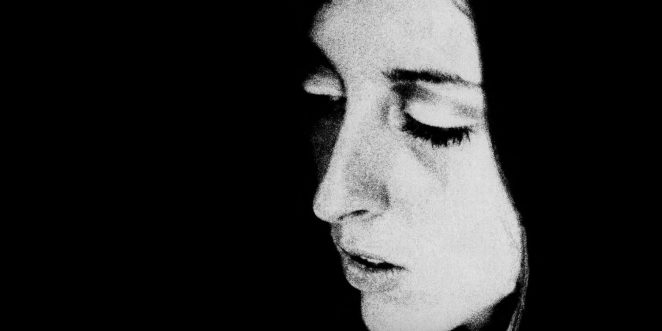
2015-11-10-1447125948-8270053-judee2-thumb

The Stars That Fame Forgot: Judee Sill

L.A.’s doomed lady of the canyon who lost her genius to drugs

Presented by David Geffen’s Asylum label as the archetypal singer-songstress of the period, Judee Sill’s background differed markedly from those of her self-absorbed peers. While Joni Mitchell and her willowy sisters worked their way round the folk circuits of Greenwich Village, Judee was being arrested for stickup jobs in the corner stores of LA’s San Fernando Valley, driven to such desperate measures by a $150-a-day heroin habit.

Sill’s intricate, mystical songs started to attract admirers on the LA scene of the late ’60s, by which time she was clean and keenly focused on her career. She briefly joined Jackson Browne, J.D. Souther, Joni Mitchell, the Eagles and Linda Ronstadt in the pantheon of West Coast talent established by David Geffen on his Asylum label. The sublime Judee Sill (1972) and Heart Food (1973) have prompted many to ask why Sill was never elevated to the heights her labelmates enjoyed.

“I knew very little about Judee,” says Graham Nash, who produced her most famous song, ‘Jesus Was A Crossmaker’. “But I do know that she was a very bright, talented, funny lady. I had no idea she was taking drugs on that scale.”

Songs such as ‘The Pearl’ and ‘The Phoenix’ are as exquisite as Nick Drake, but more schooled and complex. Classically trained, Sill combined her love of Bach and other composers with her taste for the mellow, countrified sound of ’70s California, melding them into a unique style she termed “country-cult-baroque”.

“There’s no one more important in my musical life than Judee,” says JD Souther, whose affair with Sill inspired ‘Jesus Was A Crossmaker’. “Jackson Browne was the furthest along as far as having learned songwriting, and then I met Judee and I thought, ‘Fuck, she’s school for all of us.'”

With amusing pomposity Sill informed NME that her three main influences were Pythagoras, Bach and Ray Charles. Yet there is something mathematically perfect about her best songs, which she invariably arranged — and even conducted — herself. “My music is really magnified four-part choral style,” Sill told the Los Angeles Herald Examiner. “It gets to people’s emotional centres quickly. That’s why all church music is in four-part choral style.”

Sill’s songs suggest a hippy update of the cosmic epiphanies of William Blake or perhaps the metaphysical ecstasies of Henry Vaughan. Tracks such as ‘The Lamb Ran Away With The Crown’ and ‘When The Bridegroom Comes’ are explicitly religious, though one could hardly describe them as Christian rock. Judee wouldn’t have. For her, Christ was a symbol of the elusive, yearned-for lover — “my vision of my animus”, as she put it.

After being dropped by Geffen in 1974, Sill wrote and recorded a new set of songs, the results appearing 30 years later as Dreams Come True/Hi — I Love You Right Heartily Here.

By 1975, after a bad car accident in Hollywood, she was re-addicted to opiate drugs, of both the legal and illegal variety. On November 23, 1979, she was found dead at her house on Morrison Street in the unglamorous North Hollywood area where she’d spent most of her life. Cause of death was given as “acute cocaine and codeine intoxication”.

“I can barely speak about her without crying,” says JD Souther. “She was certainly as important as Linda or Jackson or the Eagles. But it was too esoteric. Judee’s music just didn’t get out.”

*

HOW TO BUY JUDEE SILL

Judee Sill 1972 *****

Sill’s startling debut sits between Bach and The Sons Of Pioneers: a singing cowgirl backed by oboes and cors anglaises. Here is first single ‘Jesus Was A Crossmaker’, and ‘The Archetypal Man’, her sly dig at the male of the species.

Heart Food 1973 *****

Easily the equal of its predecessor, Sil’s second set gives free range to her uniquely crafted melodies in the same metaphysical vein. ‘The Pearl’ and ‘The Phoenix’ are magically lovely, while ‘Soldier Of The Heart’ pounds superbly along.

Dreams Come True… 2005 ****

Recorded in a single day at Mike Nesmith’s Countryside studio, this is funkier, more gospelly than the Asylum LPs. Songs such as ‘That’s The Spirit’ are also as effortlessly beautiful as anything on Judee Sill or Heart Food.

Abracadabra: The Asylum Years 2006 *****

New 2CD packaging of the two Asylum LPs, together with all the demos/alternate tracks from the 2003 Rhino Handmade releases. This UK-only release has an exclusive eight-minute version of Heart Food‘s ‘The Donor’.


My much longer Observer piece about Sill is available to Rock’s Backpages subscribers, along with several other pieces about her.

Memento Mori on Malta

Some pictorial souvenirs of my visit last week to Valletta on Malta and Rabat/Victoria on Gozo: these almost gleeful death-reminders from the graves of Knights of St. John in the baroque cathedrals in those cities. No flinching from the vexing business of personal extinction here

Fa-fa-fa-fashion: Vogue @ 100

405

LAST WEEKEND, owing to a funeral in my wife’s family, I had to forego the chance to rub designer shoulder pads with Anna Wintour and Victoria Beckham at one of the innumerable events lined up to celebrate the 100th birthday of Vogue.

I’d been invited because I once regularly contributed to the fashion “Bible” and had, in fact, been asked to offer up some recollections of my Vogue years for the handsome Voice of a Century coffee-table book published last week by Genesis Publications.

Among the things I wrote was this: “Vogue took me out of the blokeish world of music journalism and injected me into a milieu with which I had – and still have – a very ambivalent relationship. I liked its intense glamour but was always slightly scared and suspicious of it.” And in the end, that was why I felt relieved to send editor-in-chief Alex Shulman my apologies and say I was unable to attend.

That old ambivalence was born almost certainly of the fact that my parents scorned fashion as vain and superficial, but also from a profound lack of confidence in my own sartorial style. Yet to deny I felt any pull towards Vogue’s world would be disingenuous. The fact is, I was pathetically flattered to appear in its pages, as if somehow it hoisted me out of the grubby geekdom of music journalism and propelled me into some jet-set domain in which, in my heart, I knew I did not belong.

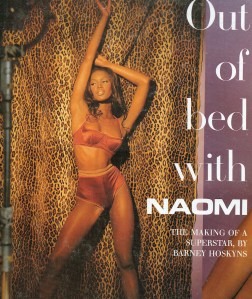
My peak Vogue moment came in the summer of 1992 when features editor Eve MacSweeney asked me to fly to New York to interview Naomi Campbell, who predictably kept me waiting in a hotel room for 24 hours. I look back now and wonder if I shouldn’t have ingratiated myself still deeper into that monde, rather than revert to blokeish type and take the staff job offered to me by fledgling music monthly MOJO.

naomi-2

With my wife, who does possess innate sartorial style, I watched both parts of the Beeb’s recent Absolute Fashion doc on Vogue and found myself feeling the same old ambivalence: how seductively luxurious it seems, how beautiful the women are… yet how absurd the preening paranoid vanity of it all… and how grotesque it all is in a world where the most traumatic suffering occurs every moment of every day.

Though I thought Alex Shulman and Lucinda Chambers came across as very grounded and unpretentious in the film – just as they did when I went in for monthly editorial meetings all those years ago – it didn’t change my fundamentally puritanical distaste for the elitism that Vogue represents and defines. I was glad that Patsy and Edina were on hand in Ab Fashion to puncture its manifest foolishness.

And so, in the end, did I regret not being at swanky private club 5 Hertford Street last Sunday to mingle with Posh Spice and Poppy Delevigne? Not really. I’d only have stood around feeling wholly out of place – knowing I don’t belong. I almost certainly had a better time in Blackpool, celebrating the life of my wife’s beloved and brilliantly funny Auntie Elma, than I’d ever have had in Mayfair.

14369925_10157460800575416_5376482762155425488_n